Xinye
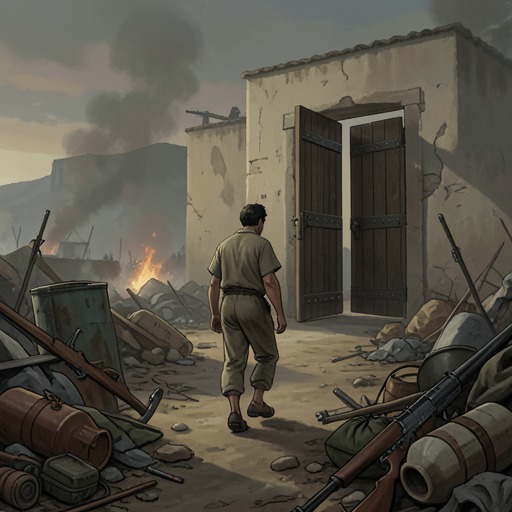
The Romance of the Three KingdomsXinye is a contested city whose importance in the story comes not from its size but from the strategies tested there. First, Xu Shu helps Xuande defeat Cao Ren’s attempts to take it, and the resulting victory gives Xuande the neighboring city of Fan. Later, as Cao Cao’s far larger army closes in, Xinye becomes the setting for Kong Ming’s first major military test and for Xuande’s effort to protect the people who depend on him. The city’s role is thus double: it is both a proving ground for command and a place Xuande is unwilling to abandon without first arranging the people’s escape.
Setting and Strategic Importance
Xinye is a small place whose vulnerability is made plain by the scale of the forces approaching it. Cao Ren is sent to seize the city and capture Xuande; later, the threat comes from Cao Cao’s army, reported to number more than one hundred thousand. Xuande’s position there cannot be understood in terms of walls and troops alone. The surrounding routes and waterways—especially Bowang and the White River—offer opportunities to misdirect an advancing army, while the city’s inhabitants make any retreat a matter of protection as well as military necessity.
The wider narrative repeatedly shows how control of territory turns on information and ground as much as numbers. At Guandu, Cao Cao faces an army about ten times the size of his own but is urged to act quickly because his supplies cannot sustain a prolonged campaign. At Jieting, Ma Su’s decision to hold a hill rather than the road leaves his troops without water and allows Sima Yi to seize the city. These later contrasts illuminate the tactical logic already evident around Xinye: advantage is not simply possession of a city, but the ability to read the approaches, supplies, and intentions that determine whether it can be held.
Xu Shu’s Defense and the Capture of Fan
Before Kong Ming arrives, Xu Shu—then known as Shan Fu—becomes Xuande’s close companion and adviser. He is impressed by the virtuous way Xuande governs and by his concern for ordinary people. When Cao Ren undertakes to take Xinye, Xuande follows Xu Shu’s advice, and Cao Ren’s repeated attempts are foiled. Xu Shu’s presence matters not only as a source of military skill but as the first demonstration, within this phase of the story, that Xuande’s fortunes can change through the counsel of a capable adviser.
Cao Ren then puts his confidence in the Eight Gates, a specialized system of attack and defense. Xu Shu identifies how it can be countered: Zhao Zilong leads five hundred selected warriors in an attack from the angle Xu Shu has advised. Cao Ren flees. Seeking to regain the initiative, he launches a night attack, but Xu Shu has anticipated it; Cao Ren’s force is ambushed, and he escapes with most of his army lost. In the aftermath Xuande captures Fan. The reversal makes the relationship between the two cities explicit: the defense of Xinye does not merely delay Cao Ren but creates the opening for Xuande to take a neighboring stronghold.
The account also clarifies the adviser’s identity after the victory. Cao Ren returns to Xuchang defeated, and Cheng Yu explains that Shan Fu’s real name is Xu Shu. Once a skilled fencer, Xu Shu had killed a man to right a wrong, refused to identify himself when captured, and was eventually freed by friends. He later became a scholar and travelled among the great masters. His concealed name and past lend a second kind of uncertainty to the Xinye campaign: the enemy has been defeated by a strategist whose identity Cao Cao’s side did not initially know.
Kong Ming’s First Test at Bowang
Xu Shu eventually leaves, but before doing so he recommends Kong Ming to Xuande. When Cao Cao’s army advances on Xinye, Kong Ming receives the authority to command, marked by a sword and seal. Guan Yu and Zhang Fei are uneasy about Xuande’s choice and expect the new adviser to fail; their skepticism makes the defense a test not only of Kong Ming’s plan but also of whether his authority will be accepted by the experienced commanders around him.
Kong Ming’s orders distribute the work across the approaches to Bowang. Guan Yu is to conceal troops in the hills and wait for the flames before striking the enemy’s rear and supply train. Zhang Fei is to hide in valleys behind a forest and attack the army’s stores at Bowang. Two commanders are assigned to prepare fires on either side of the ravine through which the enemy must advance. Zhao Zilong is to lead the advance party but pretend to flee upon meeting Cao Cao’s troops. The plan relies on separate forces responding to the same signal, turning the enemy’s advance into an exposure to attack from multiple positions.
Guan Yu and Zhang Fei dismiss the scheme, especially because Kong Ming will not be near the fighting. Xuande rebukes them, while Kong Ming’s confidence is reflected in his instruction to Sun Qian and Jian Yong to prepare victory celebrations. Even Xuande is troubled when Kong Ming orders him to abandon the camp once the enemy arrives, then turn back at the sight of the flames. The episode places confidence and uncertainty side by side: the new commander’s plan requires Xuande to act before its success is visible, while the signal of fire will bring the dispersed parts of the defense into motion.
Retreat, Civilian Protection, and the City’s Legacy
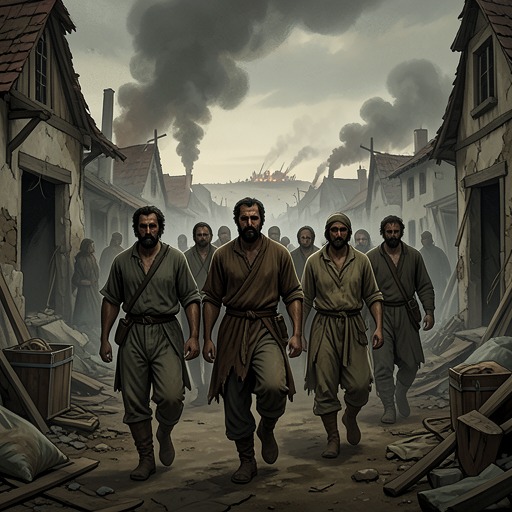
As Liu Biao’s health declines and the political situation in Jingzhou becomes dangerous, Kong Ming recognizes that Xuande must move from Xinye toward Jingzhou. After Liu Zong agrees to surrender Jingzhou to Cao Cao, a captured messenger’s letter exposes the arrangement to Xuande. Following Kong Ming’s counsel, Xuande decides to retreat toward Fan, but he refuses to leave behind the people who have followed him or the inhabitants of Xinye who rely on his protection. Moving them across the river makes the retreat a large and vulnerable operation, with Cao Cao’s army already near Bowang.
The defense is therefore planned to buy time for the population’s departure. Guan Yu is ordered to dam the upper waters of the White River and destroy the dam at the appointed time, sending a flood against the enemy. Zhang Fei is assigned the Boling crossing, where the slower current makes it a likely route for those trying to escape. Zhao Zilong divides three thousand men into four companies, stations them by Xinye’s north, south, east, and west gates, and equips them with sulphur and saltpetre to place on rooftops. The orders connect a military withdrawal to the city’s geography: river, crossing, gates, and buildings all become part of a coordinated attempt to hold off pursuit while civilians get away.
Xinye’s significance consequently extends beyond the capture or loss of a single stronghold. The earlier fighting shows Xu Shu’s tactical judgment helping Xuande defeat Cao Ren and seize Fan; the later defense presents Kong Ming’s command as a carefully staged system of signals, feints, and coordinated positions. Most importantly, Xuande’s decision to evacuate the people rather than abandon them gives the city’s threatened position an ethical dimension. Xinye is a temporary base in a broader contest for territory, but the struggle to leave it safely reveals what Xuande’s rule is meant to protect.